31 October 2015 16:00
Intertwined motifs, motifs without a beginning or an ending. These ‘infinite’ motifs usually have a symbolic meaning. This symbolism can be interpreted differently by everyone and that is what makes these motifs so popular.
Cultures
Infinite motifs occur in different cultures and almost always have a symbolic meaning, even though this meaning does have to be well-known. The old Celtic culture has the Celtic knot as an infinite motif which dates back to the 8th century. The Celtic knot, also known as the triquetra, symbolises life, death and rebirth but also the three forces of nature: earth, air and water. Indian motifs also have elegant, infinite elements, such as art objects of the Incas and Aztecs. Within the Ottoman culture and Islamic art, arabesques are a well-known example of the use of infinite motifs. Recognisable, continuous and repetitive (imaginary) lines shape the pattern. The arabesque motif has a symbolic meaning to Muslims too. Infinite motifs, like arabesques, are also featured in heraldry. In the second half of the 12th century, it was common to decorate the amour of the knights with symbolic scenes, the well-known weapons. During the Renaissance, these infinite motifs were usually whimsical, winding and symmetrical, like a stylised climbing plant. These patterns can also be seen in Antique Style Web Store, such as in the wallpaper and furniture fabrics.
19th and 20th century
Infinite motifs, patterns without a beginning or ending and floral elements are used often, particularly within the Art Nouveau movement. Usually, they are elegant flowers and plants, stems, leaves and flower buds, that have been intertwined to an infinite motif. The Art & Crafts Movement, a 19th century art movement that strove for the return of craftsmanship and simplicity of designs, also used infinite motifs. This showed the love for traditional labour. Popular, infinite motifs within Dutch art are the ingenious, mathematical patterns by M.C. Escher (1898 – 1972). The division of the surface and impossible compositions, show the way that Escher played with perspective.
Gift
The appeal of an infinite motif is that the symbolic value can be determined personally. A motif with no ending can stand for love, friendship, new life or eternity. That is why a piece of jewellery of accessory with an infinite motif makes for a beautiful gift. Antique Style Web Store has remarkable pieces of jewellery that have been inspired by Celtic design but also with floral shapes that are characteristic of the Art Nouveau style. Jewellery with more geometrical and classic motifs can also be found in the category Jewellery. In the category Picnic Cases Bags and Baskets, there is a large collection of Art Nouveau bags to choose from, in which the infinite, whimsical lines create a mysterious scene. Also have a look in the categories Furniture Fabrics, Cushions and Historical Wallpaper to see different examples of repetitive, endless motifs that appeal to the imagination.
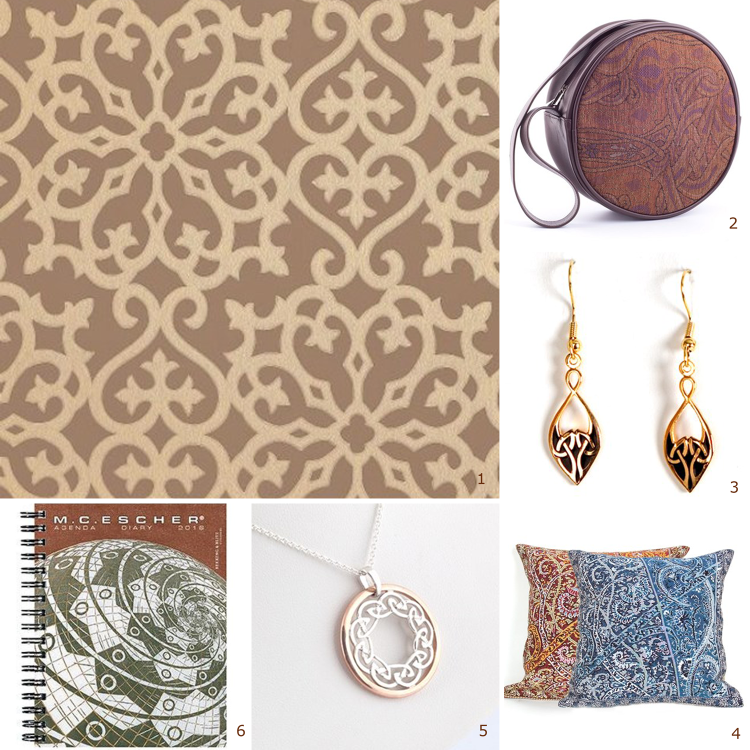
1. Wallpaper Allison 2. Handbag Rondeau Cyrene 3. Earrings Celtic Knot 4. Cushion Rajastahn 5. Necklace Twist 6. M.C. Escher Diary 2016
 ordered before 12:00, shipped today
 customers review us with 4.8/5
 🌞 Sunny Summer


 Send us a WhatsApp text
